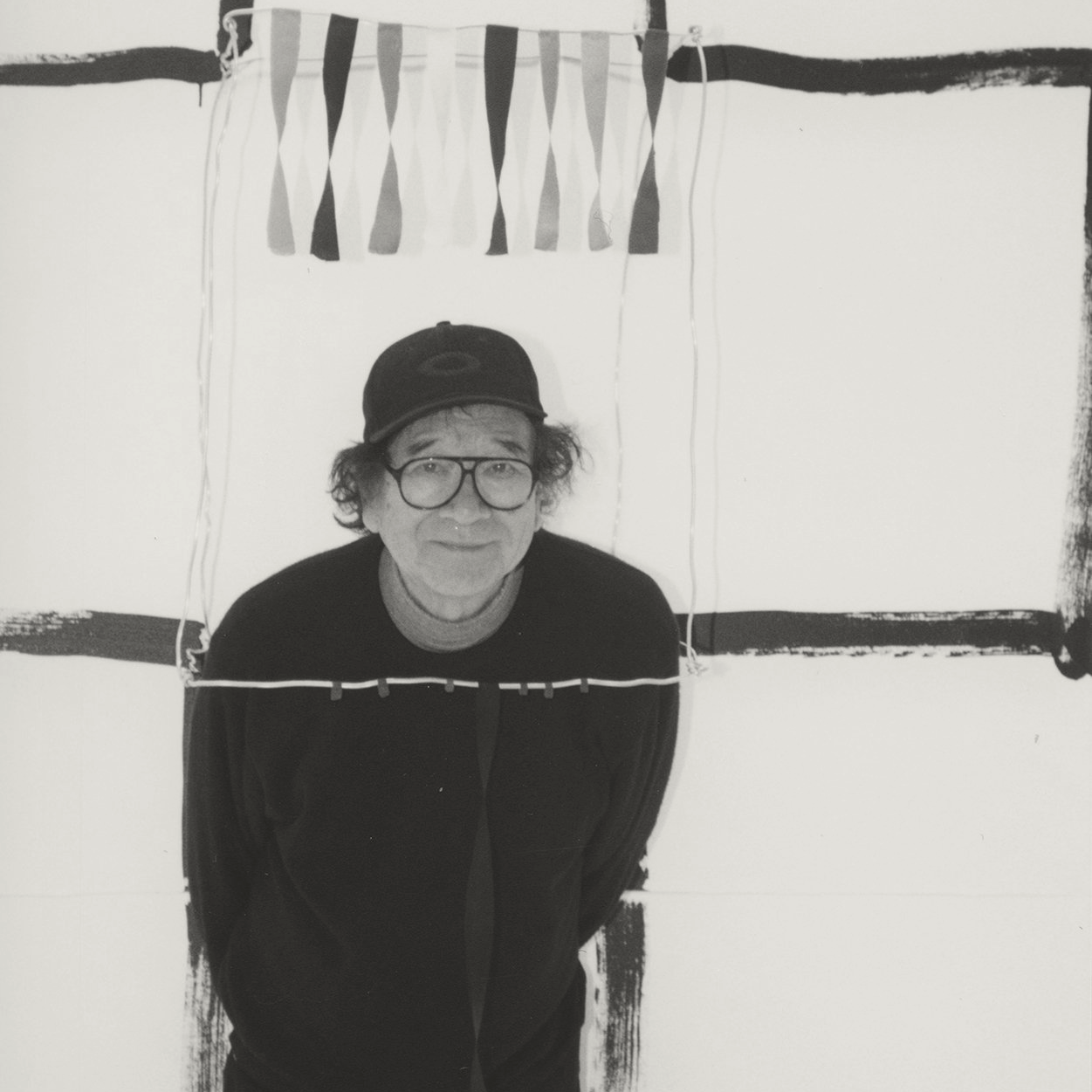
Sadamasa Motonaga
Japan
1922–2011
Sadamasa Motonaga was a leading figure of the first-generation Gutai Art Association, joining the avant-garde group in 1955. Initially recognized for his innovative installations using vibrantly colored water and smoke, he later developed a signature pouring technique with synthetic resin pigments. By working on canvases laid flat on the floor, he transformed tarashikomi (the traditional Japanese wet-on-wet "dripping-in" technique) into a modern abstract language that emphasized materiality and physicality.
The year 1966 marked a pivotal stylistic shift when Motonaga spent a year in New York as an invitee of the Japan Society. During this period, gallerist Martha Jackson introduced him to Liquitex acrylic paints, which were not yet available in Japan. Simultaneously inspired by Pop artist James Rosenquist’s use of the airbrush, Motonaga began experimenting with spray-painting, incorporating corona-like gradients and buzzing contours into his work.
Upon returning to Japan in the 1970s, he integrated the aesthetics of manga and the boundless imagination of children’s picture books into his fine art. His biomorphic forms possess an immediate, approachable charm. In his later years, Motonaga fused his early pouring experiments with his mid-career airbrush compositions; his avant-garde interpretation of anime-like iconography profoundly prefigured the later Superflat movement. Throughout his life, Motonaga resisted the rigidity of adult seriousnesswith a sense of playful humor, serving as a vital bridge between Japanese postwar and contemporary art.
Motonaga’s international acclaim is highlighted by his participation in the Venice Biennale in both 1966 and 1993. In 2015, the Dallas Museum of Art, in collaboration with the Japan Foundation, organized the major retrospective Between Action and the Unknown: The Art of Kazuo Shiraga and Sadamasa Motonaga. His work is held in prestigious permanent collections worldwide, including the Museum of Modern Art (MoMA), New York; the Solomon R. Guggenheim Museum, New York; Tate Modern, London; and M+ Museum, Hong Kong.